Recomendación de revisores con IA vs. revisión por pares tradicional: ¿Cuál ofrece mejor calidad de investigación?

Paige Watson
Published on 05 de abril de 2026
Peer review is the backbone of academic research, ensuring quality, credibility, and integrity. However, traditional peer review systems are increasingly struggling with delays, reviewer overload, and inconsistent evaluation standards.
With the rise of AI-powered reviewer recommendation systems, academic conferences and journals now have a smarter alternative. But the question remains—can AI truly deliver better research quality compared to traditional peer review?
How Traditional Peer Review Works
Traditional peer review relies heavily on manual processes where editors or organizers assign reviewers based on their knowledge and availability.
- Manual reviewer selection
- Email-based communication
- Limited visibility into reviewer expertise
While widely used, this approach often leads to inefficiencies and inconsistent outcomes.
Limitations of Traditional Peer Review
- Slow review cycles and delays
- Reviewer-paper mismatch
- High reviewer workload
- Risk of bias and subjectivity
These challenges impact both research quality and the overall conference experience.
What Is AI-Powered Reviewer Recommendation?
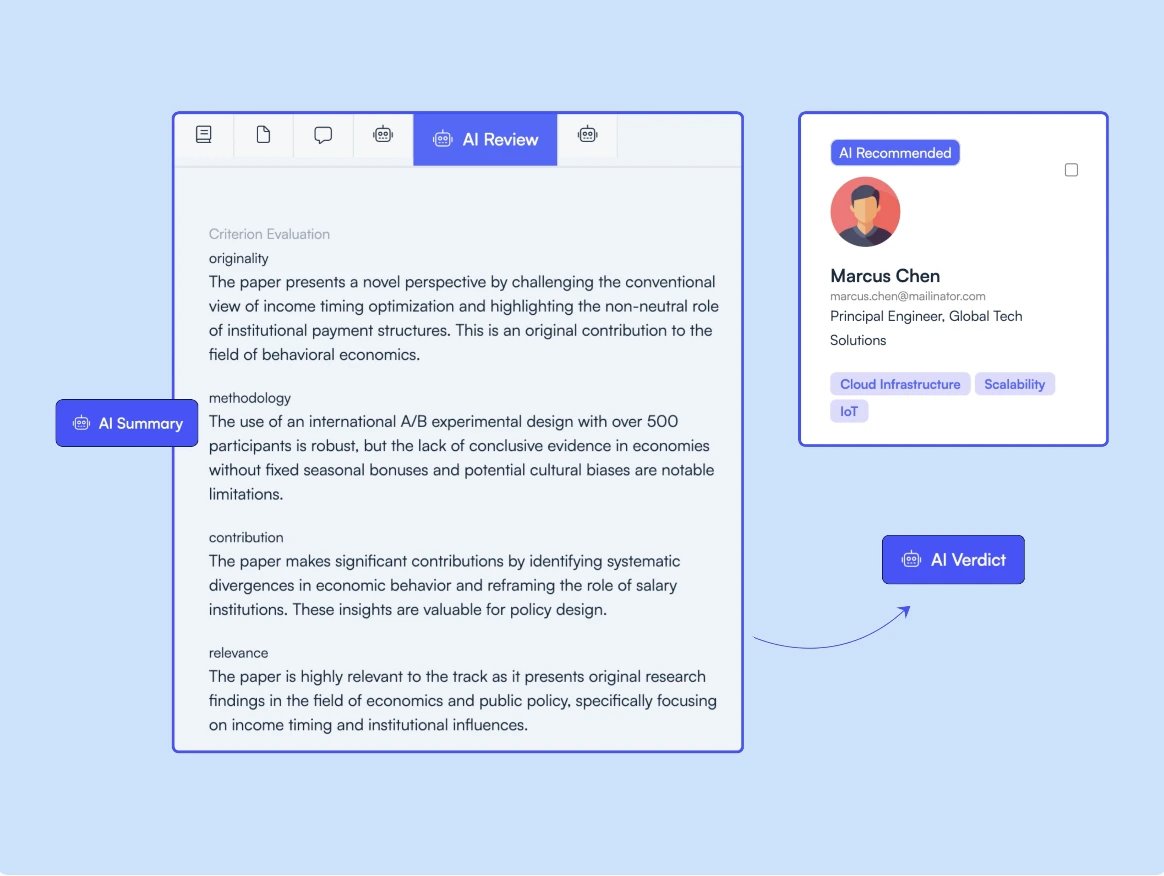
AI-powered systems use vector search and machine learning to match papers with the most relevant reviewers based on expertise and research context.
- Analyzes paper content using embeddings
- Matches with reviewer expertise semantically
- Automates reviewer assignment
This approach ensures accurate and scalable reviewer matching.
Advantages of AI Reviewer Recommendation
- Faster reviewer assignment
- Better expertise-based matching
- Reduced bias through data-driven decisions
- Scalable for large conferences
AI enables consistent and high-quality review processes across submissions.
AI vs Traditional Peer Review: Key Comparison
- Speed: Manual is slow vs AI is real-time
- Accuracy: Manual depends on human knowledge vs AI uses semantic matching
- Scalability: Manual struggles vs AI scales easily
- Bias: Manual is subjective vs AI is more consistent
The differences clearly highlight why AI is becoming the preferred approach.
How PeerSubmit Combines AI with Human Expertise
PeerSubmit uses AI-powered reviewer recommendation while keeping human oversight in the decision-making process.
- AI suggests the best reviewers
- Organizers validate and finalize assignments
- Continuous improvement through data feedback
This hybrid approach ensures both efficiency and academic integrity.
Which One Delivers Better Research Quality?
AI-powered reviewer recommendation enhances research quality by ensuring that each paper is reviewed by the most relevant experts, reducing mismatches and improving evaluation consistency.
While traditional peer review provides human judgment, AI strengthens the process by removing inefficiencies and improving accuracy.
Final Thoughts
The future of peer review is not about replacing humans with AI—it is about enhancing human decision-making with intelligent systems.
Platforms like PeerSubmit demonstrate how AI-powered reviewer recommendation can improve speed, fairness, and research quality in modern academic workflows.
Comience a Gestionar su Conferencia: Desde el Envío hasta la Decisión
Únase a cientos de organizadores que confían en PeerSubmit para gestionar sus eventos académicos con eficiencia impulsada por IA y flujos de trabajo fluidos.
Sin tarjeta de crédito • Configuración en minutos
Comparativa de Revisión por Pares con IA FAQs
Organice su Conferencia Sin Caos
Gestione envíos, revisión por pares, registros y flujos de trabajo—todo en una sola plataforma diseñada para eventos académicos.
Únase a cientos de conferencias académicas que ya utilizan PeerSubmitSin tarjeta de crédito • Configuración en minutos