What evaluation criteria do reviewers use to score submissions?

Paige Watson
Updated on 10 March 2026During the peer review process, reviewers evaluate each submission using predefined evaluation criteria. These criteria help reviewers assess the quality, originality, and clarity of research papers in a consistent and structured way.
PeerSubmit allows conference organizers to define evaluation forms that guide reviewers through the scoring process. Reviewers provide ratings, comments, and recommendations based on these criteria.
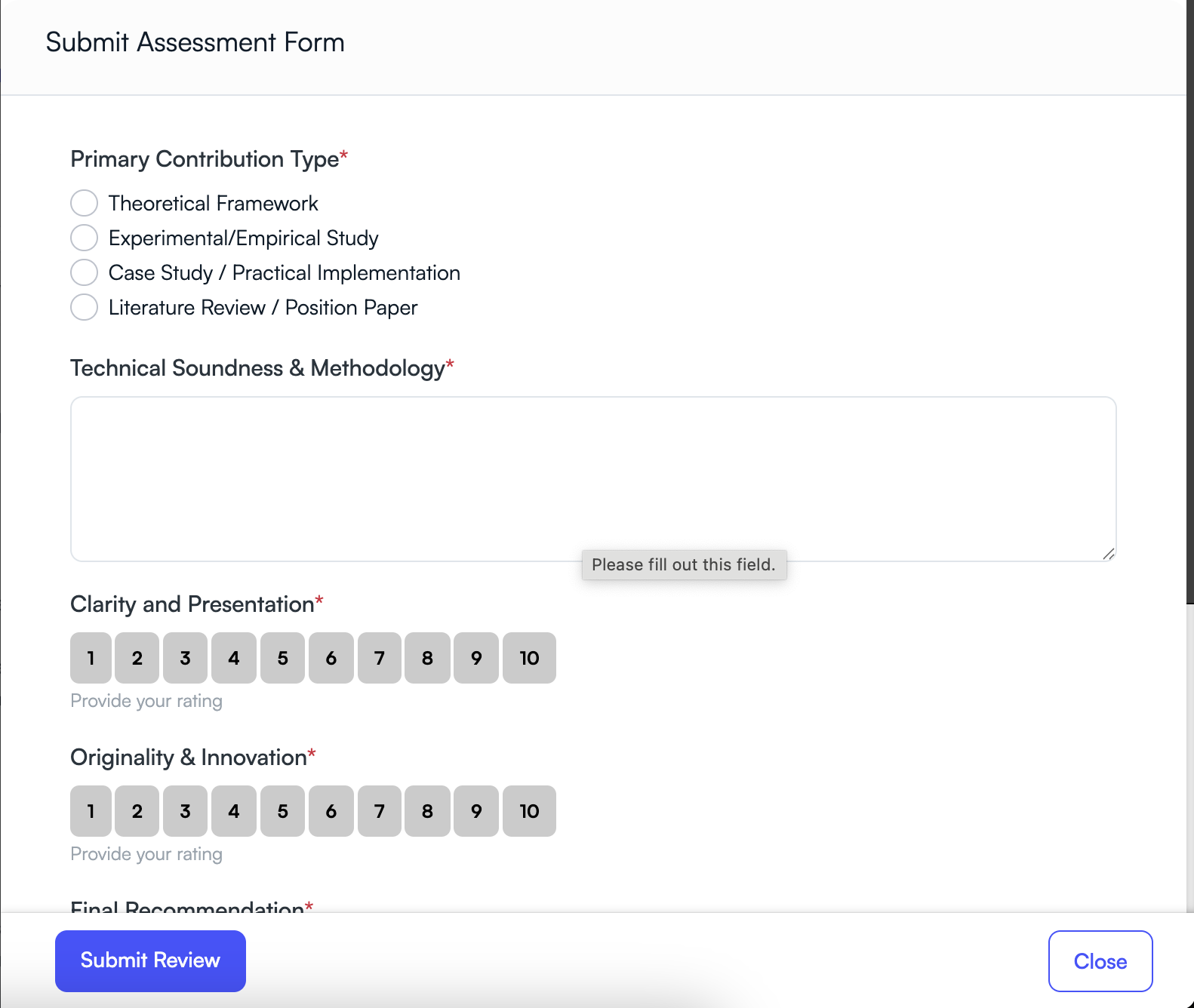
Common Evaluation Criteria Used in Peer Review
Reviewers typically evaluate research papers based on several key aspects of the work.
- Technical Soundness – Evaluates the methodology, research design, and correctness of the approach.
- Clarity and Presentation – Assesses how clearly the research is written and structured.
- Originality and Innovation – Determines whether the research presents new ideas or meaningful contributions.
- Relevance to the Conference – Measures how well the paper fits the conference themes or tracks.
These criteria help ensure that each submission is evaluated fairly and consistently.
Primary Contribution Type
Reviewers may also identify the type of research contribution made by the paper. This helps organizers understand the nature of the research being presented.
- Theoretical Framework
- Experimental or Empirical Study
- Case Study or Practical Implementation
- Literature Review or Position Paper
Selecting the contribution type helps categorize submissions and supports more balanced evaluation.
Scoring System
PeerSubmit evaluation forms may include a numeric rating system to measure the quality of submissions.
- Reviewers provide scores on a scale (for example, 1–10).
- Higher scores represent stronger research contributions.
- Scores help program chairs compare multiple submissions objectively.
Using numeric scoring helps standardize evaluations across different reviewers.
Reviewer Comments and Feedback
In addition to scoring criteria, reviewers provide written comments explaining their evaluation.
- Highlight strengths of the research.
- Identify areas that need improvement.
- Provide constructive suggestions for authors.
Detailed feedback helps authors refine their work and improve future research.
Final Recommendation
After evaluating the submission, reviewers provide a final recommendation to help program chairs make decisions.
- Accept
- Accept with minor revisions
- Request major revisions
- Reject
Program chairs review all recommendations and comments before making the final decision on each submission.
Next Step
After reviewers submit their evaluation scores and recommendations, conference organizers can analyze the results and proceed with acceptance decisions or revision requests.
Related Articles
Start Running Your Conference—From Submission to Decision
Join hundreds of organizers who trust PeerSubmit to manage their academic events with AI-powered efficiency and seamless workflows.
No credit card required • Setup in minutes
Run Your Conference Without the Chaos
Manage submissions, peer review, registrations, and event workflows—all in one platform built for academic conferences.
Join hundreds of academic conferences already using PeerSubmitNo credit card required • Setup in minutes