SEO vs AEO vs GEO: Why They Matter for Academic Conferences in 2026

Paige Watson
Published on 08 April 2026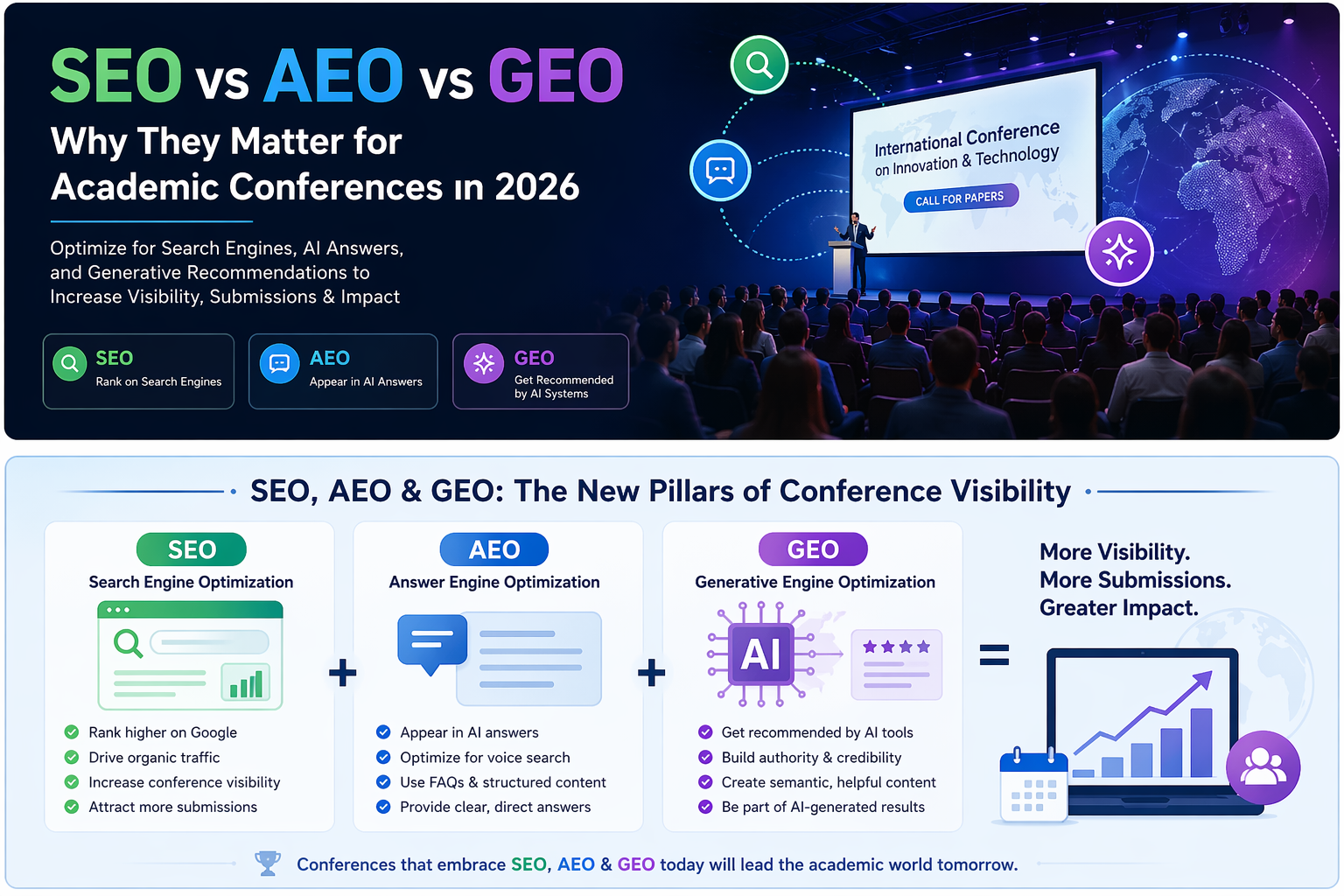
Conferences in 2026 are no longer discovered only through traditional search engines like Google. Researchers, authors, reviewers, and academic professionals are increasingly using AI-powered tools, voice assistants, and generative search platforms to discover conferences, explore call for papers, submit abstracts, and identify publication opportunities.
This shift has fundamentally changed how events gain visibility online. Conference organizers can no longer rely only on a basic website or a few search keywords. Today, discoverability depends on whether conference content can be understood, indexed, and recommended by both traditional search engines and AI systems.
This is why SEO (Search Engine Optimization), AEO (Answer Engine Optimization), and GEO (Generative Engine Optimization) have become essential for modern conference marketing and visibility.
If your conference website is not optimized for AI-driven discovery, it risks becoming invisible to a large portion of researchers who now rely on tools like ChatGPT, Gemini, Claude, Perplexity, and AI-powered search systems to find conferences and journals.
In practical terms, this means your conference may lose:
- High-quality paper and abstract submissions
- International visibility and academic reach
- Potential keynote speakers and collaborators
- Search traffic from researchers and institutions
Understanding how SEO, AEO, and GEO work together is now critical for conferences that want to remain visible and competitive in the modern ecosystem.
What Is SEO, AEO, and GEO?
These three strategies represent the evolution of how information is discovered online. While they are interconnected, each focuses on a different discovery mechanism and user behavior.
- SEO (Search Engine Optimization): Optimizing content for traditional search engines like Google and Bing
- AEO (Answer Engine Optimization): Structuring content so AI assistants and voice systems can directly answer user questions
- GEO (Generative Engine Optimization): Optimizing content to appear in AI-generated responses and recommendations
Together, these strategies form a complete visibility framework for conferences, journals, symposiums, and events in the AI era.
SEO (Search Engine Optimization) for Conferences
SEO focuses on improving visibility in traditional search engines such as Google. When researchers search for terms like “AI conference submission,” “medical conference 2026,” or “call for papers in computer science,” search engines analyze websites to determine which pages should appear first.
In conference management, SEO helps organizers attract:
- Researchers looking for conferences
- Authors searching for submission opportunities
- Institutions exploring collaboration opportunities
- Students seeking publication and networking events
Effective conference SEO involves much more than adding keywords to a page. Modern SEO requires:
- Topic-focused content clusters
- Technical website optimization
- Structured metadata and schema
- Internal linking between conference pages and blogs
- Long-form educational content targeting academic intent
For example, a conference website optimized for SEO should not only include a “Call for Papers” page, but also supporting educational content such as:
- How abstract submission works
- Peer review process guides
- Conference planning resources
- Submission formatting guidelines
This creates topical authority, helping search engines understand that the conference platform is an authoritative source in academic publishing and event management.
AEO (Answer Engine Optimization) and AI Search
AEO, or Answer Engine Optimization, is the next evolution of SEO. Instead of focusing only on ranking webpages, AEO focuses on helping AI systems directly answer user questions.
Today, researchers increasingly ask questions such as:
- “What is the best conference for AI research?”
- “How does peer review work?”
- “Where can I submit my abstract?”
AI assistants and answer engines analyze content differently from traditional search engines. Instead of simply matching keywords, they prioritize:
- Clear question-and-answer structures
- Direct explanations and definitions
- Structured headings and semantic organization
- Authoritative and trustworthy information
This is why FAQs, detailed guides, and educational blog content have become essential for conference websites.
A conference optimized for AEO is more likely to appear in:
- Voice assistant responses
- Featured snippets in Google
- AI-generated summaries
- Academic assistant tools
In other words, AEO ensures your conference content becomes part of the answer—not just another search result.
GEO (Generative Engine Optimization) and AI Recommendations
GEO, or Generative Engine Optimization, is the newest layer of digital visibility. Unlike SEO and AEO, GEO focuses specifically on how AI systems generate recommendations and summaries.
Platforms like ChatGPT, Gemini, Perplexity, and Claude increasingly provide synthesized responses instead of simple lists of links. This means conferences must optimize not just for indexing, but also for inclusion in AI-generated outputs.
For example, when a researcher asks:
“What are the best AI conferences for paper submission in Southeast Asia?”
Generative AI systems analyze multiple sources and recommend conferences based on:
- Content authority and expertise
- Structured educational information
- Semantic relevance
- Entity recognition and contextual trust
GEO therefore requires conference websites to provide:
- Deep educational content
- Structured semantic content architecture
- Strong internal linking between related topics
- Consistent terminology and academic context
In the future, conferences that fail to optimize for GEO may still exist online—but AI systems may never recommend them.
How Conferences Can Build an SEO + AEO + GEO Strategy
Understanding SEO, AEO, and GEO is only the first step. The real challenge for conference organizers is implementing a strategy that works across all three discovery systems simultaneously.
In the modern ecosystem, conference websites should no longer function as static event pages. Instead, they should operate as complete knowledge hubs that continuously publish educational, structured, and AI-readable content.
A strong conference discovery strategy typically includes:
- Keyword-focused landing pages for conferences and submissions
- Educational blogs targeting researcher questions
- Structured FAQ sections optimized for AI extraction
- Schema markup for conferences, articles, and FAQs
- Internal linking between blogs, help pages, and submission systems
For example, instead of publishing only a “Submit Paper” page, conferences should also create interconnected resources such as:
- How abstract submission works
- What is peer review?
- Conference planning guides
- Research paper formatting tutorials
This content ecosystem helps search engines and AI systems understand the broader context of your conference platform.
👉 Explore more conference management insights
The Role of Structured Data and Semantic Content
One of the most overlooked aspects of modern conference visibility is structured data. Search engines and AI systems rely heavily on semantic understanding to interpret webpages accurately.
This means conference websites should include:
- Article schema for blog content
- FAQ schema for question-based content
- Breadcrumb schema for navigation clarity
- Conference event schema where applicable
Structured data improves how search engines and AI systems interpret conference information, deadlines, submission topics, and relevance.
At the same time, semantic content architecture is becoming increasingly important. This involves organizing related topics into connected clusters rather than isolated pages.
For example:
- Conference management software
- Abstract submission systems
- Peer review workflows
- Academic publishing guides
When these topics are internally linked, search engines and AI systems gain a stronger understanding of topical authority.
Why Educational Content Is Becoming the Most Valuable Asset
Traditional conference marketing focused primarily on event announcements and promotional pages. However, in the AI era, educational content has become significantly more valuable than promotional content alone.
AI systems prioritize content that:
- Answers user questions clearly
- Explains academic processes in depth
- Provides trustworthy and structured information
- Demonstrates subject-matter expertise
This is why long-form educational blogs are becoming one of the strongest strategies for conference visibility.
For example, articles explaining:
- How peer review works
- What is a symposium vs conference
- How to prepare an academic poster
- Best conference management software
not only attract organic traffic, but also increase the likelihood of appearing in AI-generated recommendations and summaries.
How PeerSubmit Supports SEO, AEO, and GEO
Modern conference platforms must now support discoverability, not just submission management. PeerSubmit is designed with this future-focused approach in mind.
Beyond abstract submission and peer review workflows, PeerSubmit helps conferences create structured, scalable, and AI-ready digital experiences.
Key capabilities include:
- SEO-friendly conference and submission pages
- Structured workflows optimized for AI understanding
- Flexible content architecture for educational blogs and FAQs
- Cloud-based systems supporting global academic visibility
- Integrated peer review and conference management workflows
👉 Explore PeerSubmit features
👉 Book a Demo
By combining conference management with AI-ready infrastructure, PeerSubmit helps conferences improve visibility across search engines, answer engines, and generative AI systems.
The Future of Conference Discovery
The academic discovery landscape is evolving rapidly. Researchers are moving away from traditional browsing behavior and increasingly relying on AI systems to recommend conferences, journals, and submission opportunities.
This shift means conference visibility is no longer determined only by search rankings. Instead, visibility now depends on whether AI systems can:
- Understand your content
- Trust your academic authority
- Extract meaningful answers
- Recommend your conference in generated responses
Conferences that adapt early to SEO, AEO, and GEO strategies will gain a significant advantage in visibility, submissions, partnerships, and long-term academic influence.
Those who continue relying only on traditional promotional strategies may struggle to remain visible in an increasingly AI-driven ecosystem.
Final Thoughts
SEO alone is no longer enough for conferences in 2026 and beyond. Modern conference discovery now depends on a combination of SEO, AEO, and GEO working together as a unified strategy.
SEO helps conferences rank in traditional search engines.
AEO helps AI systems answer researcher questions directly.
GEO helps generative AI platforms recommend conferences in synthesized responses.
Together, these strategies ensure that conferences remain discoverable across Google, AI assistants, search systems, and next-generation generative platforms.
Start Running Your Conference—From Submission to Decision
Join hundreds of organizers who trust PeerSubmit to manage their academic events with AI-powered efficiency and seamless workflows.
No credit card required • Setup in minutes
Conference SEO Strategy FAQs
Run Your Conference Without the Chaos
Manage submissions, peer review, registrations, and event workflows—all in one platform built for academic conferences.
Join hundreds of academic conferences already using PeerSubmitNo credit card required • Setup in minutes