Best Microsoft CMT Alternatives for Conference Management

Paige Watson
Published on 03 January 2026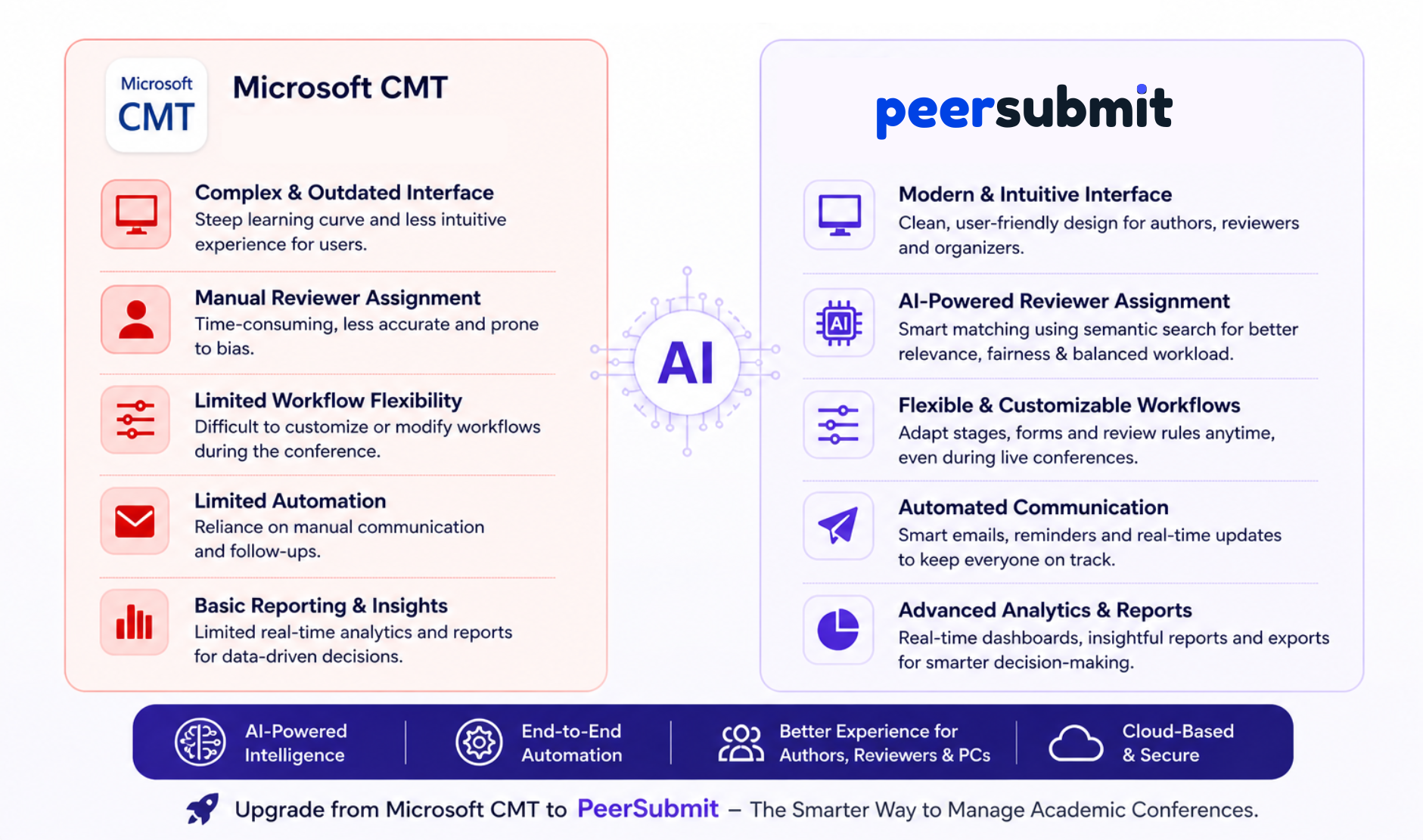
Microsoft CMT (Conference Management Toolkit) has been a trusted platform in academic communities for years, particularly in large-scale research conferences. It provides a structured environment for managing submissions, assigning reviewers, and handling decision workflows.
However, the way academic conferences operate today has changed significantly. Organizers are no longer just managing submissions—they are managing complex, multi-stage workflows that require flexibility, speed, and seamless coordination between authors, reviewers, and committees.
This shift has led many organizers to actively explore best Microsoft CMT alternatives that offer a more modern approach to conference management software, combining usability, automation, and intelligent systems.
👉 Understand modern conference workflows
Why Organizers Are Moving Beyond Microsoft CMT
Microsoft CMT was designed for structured academic workflows, but those workflows have become more dynamic over time. Conferences now involve multiple submission types, evolving review criteria, and tighter timelines.
In practice, organizers often encounter challenges such as:
- Complex interface that requires training for authors and reviewers
- Manual reviewer assignment, especially for interdisciplinary submissions
- Limited flexibility when modifying workflows mid-conference
- Heavy reliance on external tools for communication and tracking
These limitations are manageable in smaller conferences, but they become significant bottlenecks in large-scale or international events.
What a Modern Microsoft CMT Alternative Should Offer
Replacing Microsoft CMT is not just about switching tools—it’s about upgrading how your conference operates.
A modern academic conference management system should support:
- Flexible abstract submission and manuscript workflows
- Customizable peer review processes (single-blind, double-blind, hybrid)
- AI-powered reviewer recommendation instead of manual assignment
- Automated communication and deadline management
- Real-time visibility into submissions, reviews, and decisions
👉 Learn more about peer review workflows
Top Microsoft CMT Alternatives for Conference Management
1. PeerSubmit (AI-First Conference Management Platform)
PeerSubmit is built specifically for modern academic conferences that need more than just submission tracking. It is designed as a complete system that connects abstract submission, peer review, decision-making, and program creation into a single workflow.
Unlike traditional platforms where each stage is handled separately, PeerSubmit treats the entire conference lifecycle as a connected process. This reduces friction between stages and eliminates the need for manual coordination across tools.
At a deeper level, what differentiates PeerSubmit is not just features—it is how those features work together.
Flexible Abstract Submission & Form Builder
In real conferences, submission requirements are rarely fixed. Different tracks require different data, and changes often happen mid-process.
PeerSubmit addresses this by allowing organizers to:
- Create fully customizable submission, author, and metadata forms
- Import or reuse forms across multiple conferences
- Modify forms even during live submissions without data loss
- Support multilingual forms for international audiences
AI-Powered Reviewer Assignment (Core Advantage)
One of the most time-consuming tasks in conference management is reviewer assignment. In traditional systems like CMT, this is often done manually or with limited filtering.
PeerSubmit replaces this with an AI-driven system that uses semantic understanding and vector-based matching to connect papers with the most relevant reviewers.
This results in:
- Better reviewer-paper alignment based on actual content
- Reduced reviewer overload through workload balancing
- Faster assignment process with higher accuracy
👉 How AI reviewer matching works
Workflow Automation & Real-Time Coordination
Conference workflows are not just about tasks—they are about coordination. Delays often happen because of manual follow-ups and missed communication.
PeerSubmit automates this layer by:
- Sending automated reminders to reviewers
- Triggering notifications at each workflow stage
- Providing real-time dashboards for organizers
This reduces delays and ensures deadlines are consistently met.
Decision Flow & Conference Program Creation
Once reviews are completed, the challenge shifts to decision-making and program structuring. In many systems, this stage is disconnected from submission and review.
PeerSubmit keeps everything connected:
- Assign decisions based on review data
- Group accepted papers into sessions
- Build structured conference programs
Reporting, Outputs & Data Control
Academic conferences require structured outputs for publication and reporting.
PeerSubmit enables organizers to:
- Generate abstract booklets and proceedings
- Export data to CSV or Excel
- Maintain a complete submission archive
👉 Explore full platform features
Let us show you around.
Join hundreds of organizers who trust PeerSubmit to manage their academic events with AI-powered efficiency and seamless workflows.2. Ex Ordo
Ex Ordo is a well-established alternative to Microsoft CMT, known for its emphasis on usability and streamlined conference workflows. It is designed to simplify the experience for both organizers and participants, particularly in managing submissions, peer review, and program scheduling.
One of its key strengths lies in its intuitive interface. Compared to more technical systems like CMT, Ex Ordo reduces the learning curve, allowing authors, reviewers, and committee members to navigate the platform more easily without requiring extensive onboarding.
From a workflow perspective, Ex Ordo provides a structured environment for:
- Abstract and paper submission management
- Peer review coordination with customizable evaluation criteria
- Conference program creation and session scheduling
This makes it a reliable choice for conferences that want a more user-friendly system while still maintaining traditional academic workflows.
However, while Ex Ordo improves usability and organization, it largely follows conventional workflow structures. Tasks such as reviewer assignment and workflow optimization still depend heavily on manual configuration and organizer input.
As conference management continues to evolve, especially with the introduction of AI-driven systems, platforms that rely primarily on structured but manual workflows may face limitations in scalability, efficiency, and automation.
3. Oxford Abstracts
Oxford Abstracts is a modern conference management platform built around flexibility and customization. It is designed to adapt to a wide range of academic events, from small symposiums to large international conferences, where submission and review workflows may differ significantly.
One of its main strengths is its ability to accommodate different formats. Organizers can configure submission types, review processes, and program structures based on the specific needs of their event rather than following a rigid predefined system.
From a workflow perspective, Oxford Abstracts supports:
- Flexible abstract and paper submission management
- Customizable peer review workflows with scoring and feedback
- Program building and session organization tools
This flexibility makes it particularly useful for conferences that require non-standard workflows or frequent adjustments during the submission and review stages.
However, while Oxford Abstracts offers strong customization capabilities, it primarily focuses on structured workflow configuration rather than intelligent automation. As a result, tasks such as reviewer assignment, workflow optimization, and decision coordination still depend heavily on manual input from organizers.
For conferences seeking deeper automation, especially in areas like AI-driven reviewer matching and workflow optimization, this can become a limiting factor as scale and complexity increase.
4. EasyChair
EasyChair is one of the most widely used conference management systems and has been a standard choice in academic communities for many years. It provides a structured environment for managing submissions, assigning reviewers, and handling peer review workflows.
Its strength lies in its familiarity. Many researchers and organizers have used EasyChair across multiple conferences, making it a dependable option for teams that prefer established systems.
From a functional standpoint, EasyChair supports:
- Abstract and paper submission management
- Reviewer assignment and peer review tracking
- Basic decision workflows and communication tools
However, EasyChair reflects an earlier generation of conference management platforms. While it is reliable, it often requires manual coordination and lacks the usability improvements and automation features found in modern systems.
Organizers frequently need to rely on external tools for communication, tracking, and reporting, which can lead to fragmented workflows—especially in larger or international conferences.
As expectations evolve toward more intuitive interfaces, automated processes, and AI-assisted workflows, traditional systems like EasyChair can become less efficient for managing complex conference environments.
Regional Perspective: Choosing the Right Conference Management Tool
Conference management requirements vary significantly across regions, and selecting the right conference management software depends on factors such as submission volume, academic standards, budget constraints, and technology adoption.
What works for a large international conference in the United States may not be suitable for a growing academic event in India or a specialized symposium in Europe. Understanding these regional differences is essential when evaluating Microsoft CMT alternatives or any modern conference submission system.
In the United States, conferences often handle hundreds or even thousands of submissions. This scale makes automation, AI-powered reviewer assignment, and real-time tracking critical. Organizers rely on platforms that can reduce manual coordination, optimize reviewer workloads, and ensure timely decision-making across large program committees.
In the United Kingdom and Europe, the emphasis is more on structured peer review processes, transparency, and academic integrity. Conferences in these regions often require detailed evaluation criteria, standardized workflows such as single-blind or double-blind review, and systems that maintain consistency across multiple review stages.
In India, academic conferences are growing rapidly, with increasing participation from universities and research institutions. Organizers typically look for affordable conference management software that still provides flexibility, ease of use, and core capabilities such as abstract submission, reviewer assignment, and automated communication. Simplicity and adaptability are especially important for teams managing conferences with limited administrative support.
In regions like Canada and Singapore, there is a strong shift toward modern, cloud-based conference submission systems that support collaboration, remote participation, and hybrid event formats. These conferences often adopt newer technologies faster, including AI-driven workflow automation and integrated reporting tools.
In emerging academic markets such as Mexico and Nigeria, accessibility and usability play a crucial role. Organizers prefer platforms that are easy to implement, require minimal training, and support multilingual workflows to enable broader participation across diverse research communities.
Across all regions, one clear trend is emerging: conferences are moving away from rigid, manual systems toward flexible, cloud-based platforms that combine automation, usability, and intelligent workflows. The ability to adapt to regional needs while maintaining global standards is what defines the next generation of conference management systems.
Final Thoughts
Microsoft CMT has played a foundational role in academic conference management, especially for large-scale research events that require structured submission and peer review workflows. For many years, it has provided a reliable system for handling complex conference processes.
However, the expectations of modern academic conferences have evolved. Today’s organizers are not just managing submissions—they are managing dynamic, multi-stage workflows that require flexibility, automation, and seamless coordination across authors, reviewers, and committees.
As a result, many are now exploring Microsoft CMT alternatives that go beyond basic functionality. Modern conference management software is expected to streamline the entire lifecycle—from abstract submission to peer review and final decision—while reducing manual effort and improving overall efficiency.
There is also a growing shift toward AI-driven peer review systems, where tasks like reviewer assignment and workflow coordination are enhanced through intelligent automation. This not only speeds up the process but also improves accuracy and consistency across reviews.
Whether you are organizing a conference in the US, UK, India, or globally, choosing the right platform directly impacts submission quality, reviewer experience, and the success of your event.
If you're evaluating a transition from Microsoft CMT, the focus should be on finding a system that aligns with modern expectations—one that is flexible, user-friendly, and capable of handling growing complexity without increasing operational overhead.
Start Running Your Conference—From Submission to Decision
Join hundreds of organizers who trust PeerSubmit to manage their academic events with AI-powered efficiency and seamless workflows.
No credit card required • Setup in minutes
Microsoft CMT Alternatives FAQs
Run Your Conference Without the Chaos
Manage submissions, peer review, registrations, and event workflows—all in one platform built for academic conferences.
Join hundreds of academic conferences already using PeerSubmitNo credit card required • Setup in minutes