Best EasyChair Alternatives for Conference Management in 2026

Paige Watson
Published on 03 January 2026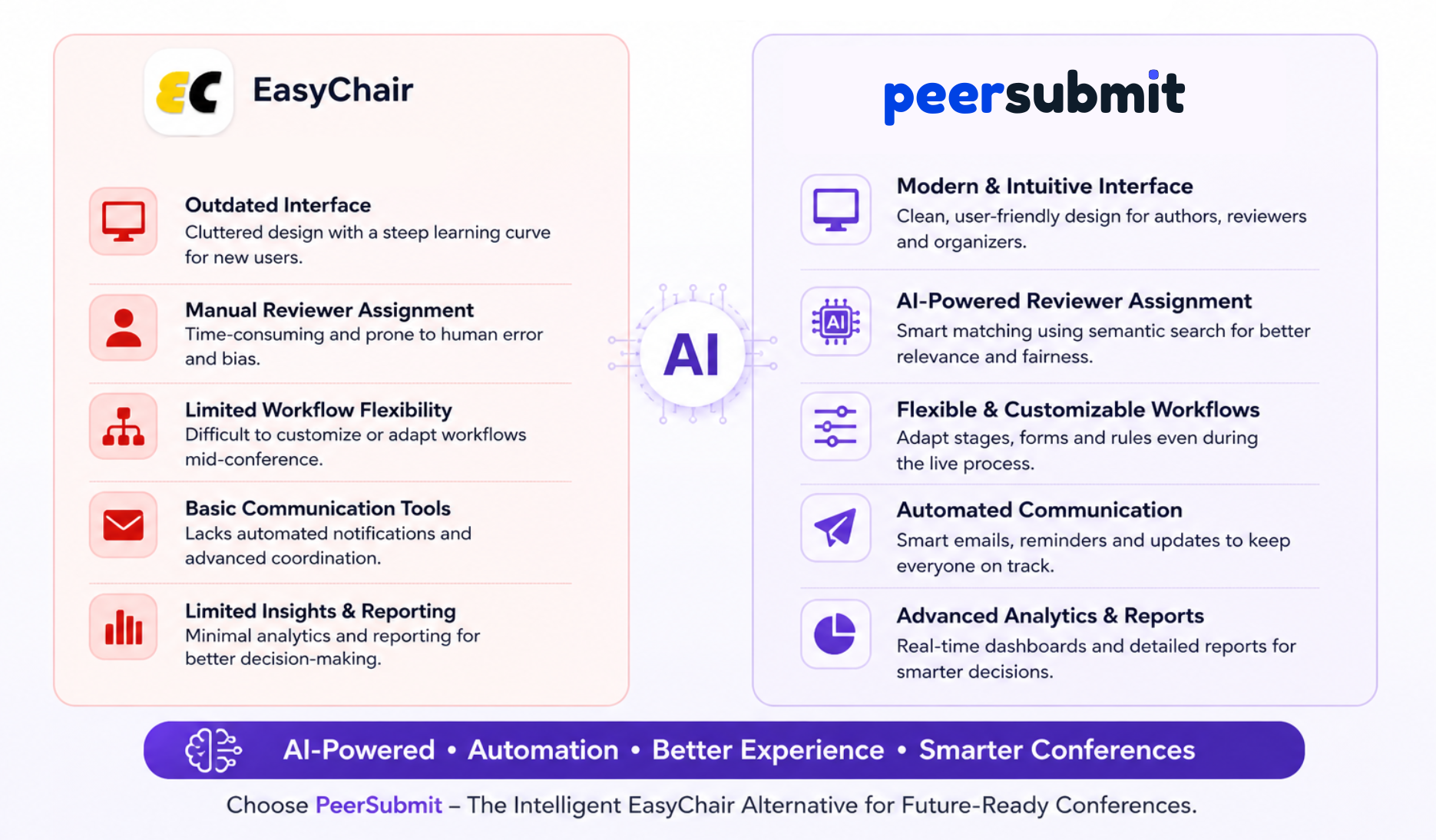
EasyChair has been one of the most widely used tools for academic conference management for years. But as research workflows evolve and expectations increase, many organizers are now actively searching for better, more modern alternatives.
If you've ever struggled with complex interfaces, limited automation, or manual reviewer assignment in EasyChair, you're not alone. Today’s conference organizers expect platforms that are intuitive, scalable, and powered by AI—not tools designed for workflows from a decade ago.
This guide explores the best EasyChair alternatives available today, focusing on usability, automation, and advanced features like AI-powered peer review systems. 👉 Explore complete conference management workflow
Why Organizers Are Moving Away from EasyChair
EasyChair is functional, but it comes with limitations that become more visible as conference scale increases.
Common challenges include:
- Outdated interface and user experience
- Manual reviewer assignment process
- Limited automation in workflows
- Complex navigation for authors and reviewers
These issues make it difficult to manage modern conferences efficiently, especially when handling large volumes of submissions.
What to Look for in an EasyChair Alternative
Before choosing a new platform, it’s important to understand what actually improves your workflow.
A modern academic conference management software should provide:
- User-friendly abstract submission system
- Automated peer review workflows
- AI-powered reviewer recommendation
- Cloud-based access and real-time tracking
- Automated email notifications
👉 Learn more about abstract submission systems and peer review workflows
These features are no longer optional—they are essential for efficient conference management.
Top EasyChair Alternatives in 2026
1. PeerSubmit (AI-First Conference Management Platform)
PeerSubmit is designed for modern academic conferences that demand efficiency, flexibility, and intelligent automation. Unlike traditional systems that focus only on submission handling, PeerSubmit provides a complete, end-to-end workflow covering abstract submission, peer review, decision-making, and program management.
It replaces fragmented processes—such as spreadsheets, emails, and manual tracking—with a unified platform that gives organizers full visibility and control over the entire conference lifecycle.
Abstract Submission & Custom Form Builder
PeerSubmit offers a highly flexible abstract and paper submission system that adapts to different conference requirements. Organizers can create fully customized submission forms tailored to their event—whether collecting abstracts, full papers, or research synopses.
The platform allows you to:
- Build custom submission, author, and metadata forms
- Import predefined fields or templates
- Modify forms anytime—even during a live conference—without data loss
- Support multilingual forms for global conferences
This level of flexibility is essential for conferences with evolving requirements and international participants.
AI-Powered Reviewer Recommendation
One of PeerSubmit’s most powerful capabilities is its AI-driven reviewer assignment system. Instead of manually selecting reviewers based on limited information, the platform uses semantic analysis and vector-based matching to recommend reviewers based on actual research content.
This results in:
- More accurate reviewer-paper matching
- Balanced reviewer workloads
- Reduced bias in the review process
The system supports single-blind, double-blind, and fully customized peer review workflows.
Workflow Automation & Smart Notifications
PeerSubmit automates key parts of the conference workflow, reducing the need for manual coordination. From submission confirmations to reviewer reminders and decision notifications, communication is handled automatically.
Organizers can:
- Send bulk or personalized emails
- Schedule automated reminders for reviewers
- Track submission and review progress in real time
This ensures deadlines are met without constant follow-ups.
Decision Management & Conference Program
Once reviews are completed, PeerSubmit allows organizers to manage decisions and build the conference program seamlessly.
You can:
- Assign accept/reject decisions based on review data
- Organize accepted papers into sessions
- Prepare structured conference programs efficiently
This creates a continuous flow from submission to final program—without disconnected steps.
Reporting, Export & Outputs
PeerSubmit provides all essential outputs required for academic conferences and publications.
Organizers can easily:
- Export data to CSV or Excel
- Generate abstract booklets and proceedings
- Maintain a complete submission archive
These features simplify reporting and post-conference documentation.
Built for Global Academic Conferences
PeerSubmit is designed to support conferences across regions including the US, UK, India, Europe, and beyond. Its flexible workflows, multilingual support, and scalable infrastructure make it suitable for both small symposiums and large international conferences.
Whether you are managing a few dozen submissions or thousands, the platform adapts without increasing complexity.
Why PeerSubmit Is a Strong EasyChair Alternative
PeerSubmit is not just an alternative—it is a modern upgrade. It replaces manual processes with automation, improves reviewer assignment using AI, and provides a user-friendly experience for authors, reviewers, and organizers alike.
Let us show you around.
Join hundreds of organizers who trust PeerSubmit to manage their academic events with AI-powered efficiency and seamless workflows.
To explore all capabilities in detail, visit:
👉 PeerSubmit Features
👉 Help Center & Documentation
👉 How AI reviewer assignment works
2. Ex Ordo
Ex Ordo is a well-known alternative to EasyChair, recognized for its clean interface and structured approach to conference management. It is particularly popular among organizers looking for a more user-friendly system while maintaining traditional peer review workflows.
It simplifies key processes such as abstract submission, peer review, and program management, making it suitable for academic conferences of different sizes.
Key Features of Ex Ordo:
- Abstract Submission: Authors can submit abstracts through customizable forms, with support for multiple file formats and collaborative submissions.
- Peer Review: Provides structured peer review workflows with customizable evaluation criteria, reviewer feedback, and scoring systems.
- Program Management: Enables organizers to build and manage conference schedules, assign session chairs, and update program details dynamically.
- Registration & Payments: Includes a registration system with online payment support and customizable attendee forms.
- Collaboration Tools: Supports communication between organizers, reviewers, and participants through built-in messaging and discussion features.
Ex Ordo is a strong choice for organizers who want a more intuitive experience compared to traditional systems, while still following structured and familiar workflows.
3. Oxford Abstracts
Oxford Abstracts is another modern conference management platform focused on flexibility and ease of use. It is widely used for abstract management and academic event organization, particularly by institutions that require customizable workflows.
The platform emphasizes simplicity while still providing powerful tools for managing submissions and conference programs.
Key Features of Oxford Abstracts:
- Abstract Management: Allows organizers to collect and manage abstracts with customizable submission forms and structured data handling.
- Peer Review: Supports multiple review models, including single-blind and double-blind workflows with scoring and feedback options.
- Flexible Workflows: Adapts to different conference formats, including symposiums, workshops, and large academic events.
- Program Builder: Helps organizers structure sessions and create conference schedules efficiently.
- Data Export: Enables export of submissions and reports for further analysis or publication.
Oxford Abstracts is often chosen by organizers who prioritize flexibility and customization in their conference workflows.
4. Microsoft CMT
Microsoft CMT (Conference Management Toolkit) is widely used in academic and research communities, especially in large conferences. It offers a structured system for managing submissions and peer review processes.
While powerful, it is often considered more technical and less user-friendly compared to newer platforms.
Key Features of Microsoft CMT:
- Submission Management: Supports paper and abstract submissions with structured workflows.
- Peer Review: Enables detailed reviewer assignment, scoring, and evaluation tracking.
- Access Control: Provides role-based permissions for organizers, reviewers, and authors.
- Scalability: Suitable for large-scale conferences with high submission volumes.
CMT is often used in large academic conferences, particularly in the US, but may require more technical familiarity compared to modern tools.
AI Is Changing Conference Management
The biggest shift in conference software today is the introduction of AI into core workflows.
AI-powered systems can:
- Automatically match reviewers based on expertise
- Analyze submissions using semantic search (RAG-based systems)
- Reduce manual coordination and delays
This is particularly important for large conferences where manual processes become a bottleneck.
👉 Read more about AI-based reviewer matching and how vector search improves peer review accuracy.
Regional Perspective: Choosing the Right Conference Management Tool
Conference management requirements are not the same across all regions. Factors such as submission volume, academic standards, budget constraints, and technology adoption play a significant role in selecting the right conference management software.
Understanding these regional differences helps organizers choose a platform that aligns with both operational needs and participant expectations.
In the United States, academic conferences often handle large-scale participation with hundreds or thousands of submissions. This makes scalability, automation, and efficient peer review workflows essential. Organizers increasingly rely on modern systems with AI-powered reviewer assignment and real-time tracking to manage complexity.
In the United Kingdom and Europe, the focus shifts toward structured peer review processes, compliance, and academic integrity. Conferences in these regions require platforms that support detailed evaluation criteria, transparent workflows, and standardized review systems such as single-blind and double-blind peer review.
In India, the demand for academic conferences is growing rapidly. Organizers often look for affordable conference management software that still offers flexibility, scalability, and core features like abstract submission, reviewer assignment, and automated communication. Ease of use is particularly important for teams managing conferences with limited administrative resources.
Across regions like Canada and Singapore, there is a growing emphasis on modern, cloud-based conference submission systems that support collaboration, remote participation, and hybrid event formats. These regions often adopt newer technologies faster, including AI-based workflow automation.
In emerging academic markets such as Mexico and Nigeria, accessibility and usability play a key role. Organizers prefer platforms that are easy to implement, support multilingual workflows, and enable broader participation without increasing operational complexity.
Ultimately, the best conference management platform is one that can adapt to these regional requirements while maintaining consistent performance, flexibility, and scalability across global academic events.
Whether you are organizing a conference in the US, UK, India, or globally, choosing the right platform is no longer just a technical decision—it directly impacts the efficiency, quality, and overall experience of your academic event.
If you're evaluating a switch from EasyChair, the best approach is to explore a platform that aligns with modern expectations of automation, usability, and scalability.
👉 Book a Demo to see how PeerSubmit simplifies abstract submission, peer review, and conference management workflows.
👉 View Pricing Plans
However, the expectations of modern conferences have changed. Today’s organizers are managing larger submission volumes, tighter timelines, and more complex workflows that require flexibility, automation, and better user experience.
As a result, many are now actively exploring best EasyChair alternatives that offer more than just basic functionality. Modern academic conference management software is expected to reduce manual effort, streamline the peer review process, and provide intelligent features like AI-powered reviewer recommendation and automated communication.
At the same time, usability has become a critical factor. Authors, reviewers, and committee members expect intuitive systems that simplify submission, review, and decision-making—not tools that require extensive training or manual coordination.
Whether you are organizing a conference in the US, UK, India, or globally, choosing the right platform is no longer just a technical decision—it directly impacts the efficiency, quality, and overall experience of your academic event.
Start Running Your Conference—From Submission to Decision
Join hundreds of organizers who trust PeerSubmit to manage their academic events with AI-powered efficiency and seamless workflows.
No credit card required • Setup in minutes
EasyChair Alternatives FAQs
Run Your Conference Without the Chaos
Manage submissions, peer review, registrations, and event workflows—all in one platform built for academic conferences.
Join hundreds of academic conferences already using PeerSubmitNo credit card required • Setup in minutes